Life in the UK test Information
- About the test
- Booking the test
- Test preparation
- What to expect at the test centre?
- Common Issues
- Using this website
About the life in the UK test
What is the life in the UK test?
Life in the UK test is a computer based multiple choice test containing 24 questions and is designed to test applicant's knowledge of life in the United Kingdom.
Who has to prepare for the test?
Everybody in the age bracket of 18-64 is required to pass this test as part of their citizenship or indefinite leave to remain (ILR) application
Who has to do the test?
You don’t need to take the test if:
- You're under 18 or over 65
- Unable to, because of special circumstances (such as a long-term physical or mental condition; you will need to provide necessary proof)
You only need to pass the test once – you don't need to pass the test again if you're applying to become a British citizen and previously passed the life in the UK test as part of your settlement (ILR) application.
What is the passmark for the test?
You must score 75% or more to pass the test. This is equivalent to answering 18 or more out of 24 questions correctly.
Booking the test
How to book the test?
You must use the official booking website to book the test. You will need to select your preferred test location from a list of available test centres. There is no difference in test difficulty between the test centres and we advise you to use the closest one.
How much does it cost to book the test?
The fee to take test is £50. This is the total fee you should be paying. If you are paying more than £50, you are probably using 3rd party providers to book the test on your behalf.
What documents do I need to book the test?
You will need to prove your identity when booking the test. Furthermore, you will need to bring the ID that you used to book the test (you might not be allowed to sit the test otherwise) with you to the test centre. Currently, the following ID's are accepted:
- Passport (can be expired)
- UK Driving Licence
- European ID Card
- Biometric Residence Permit
Special circumstances when booking the test
If you need special arrangements (e.g. disability), please call 0800 015 4245 to get extra help
Test preparation
What do I need to know for the test?
You need to know the information contained in the 3rd edition handbook "Life in the United Kingdom: A guide for new Residents". Every single question in the official test will be based on this book.
How can I prepare for the test?
Our life in the UK tests together with the study guide are part of the essential preparation for the test.
You should consider our premium membership to unlock features such as audio questions, highlighted common exam questions, personalised dashboard and many more that will help in your test preparation. It's recommended to read and study the contents of the handbook before attempting our practice tests. Our practice tests are highly realistic, both in terms of difficulty and test layout, making them ideal preparation materials before the test. We strongly advise you complete all 45 practice tests which will cover all of the required material and give you extra confidence, however many people pass after completing just the first 10 of our practice tests.
How difficult is the official test?
The official test selects 24 randomly generated questions from the database, making every single test unique in terms of difficulty. Our sample tests cover all of the essential facts that you should know for the test, so you can rest assured regardless of the questions that come up in your test.
What is the difference between different handbooks?
The life in the UK test was last updated in 2013 (the 3rd edition update). Consequently, all 2013-2018 published handbooks and study guides contain the same information. You don't need to buy a paper copy and can read it online.
How do we pick the questions?
We carefully select questions from the Study Materials. All of our questions are valid for all exams taking place after 2013, because they are based on the 3rd edition handbook. We aim to provide only the best and most relevant questions to make your preparation pay off in the end.
Will these questions appear in my official test?
Yes and No, the official life in the UK test is a selection of randomly selected questions from their own database. Our questions are designed to be similar to those in the official test, they might actually come up. You will be surprised how easy it is to pass your official test after completing our tests.
Tips for the test
Take your time to read and answer the questions. It's important to pay attention to the question and read it as many times as you need to make sure that you understand it correctly. You are allowed 45 minutes to complete the test, that is just under 2 minutes per question.
Pay attention to the type of question asked. Some questions will have more than 1 correct answer. In such cases, make sure that you select as many correct options as the question asks.
What to expect at the test centre?
How long will I spend at the test centre?
Make sure to give yourself a two-hour slot for the test. We advise you to arrive 15 minutes early to be on the safe side. The identity checks should take another 15 minutes and you will be given 45 minutes to complete the test. Additionally, if you choose to do a practice test to familiarise yourself with the test format you will need even more time. The waiting time for the result is usually less than 5 minutes and you will be able to leave the test centre upon receiving your pass (or fail) certificate.
Identity checks
This is a standard procedure operated by every approved test centre. You will be required to show the identification used when booking the test and show the true likeliness of the person displayed on the ID.
Can I bring visitors/guests?
Not all test centres will allow visitors/guests. However, you will be able to bring guests to the British Citizenship ceremony.
What happens if I pass?
Upon passing the life in the UK test, you will receive a pass certificate. This certificate has no expiry date, and can be used for all future applications.
What happens if I fail?
If you fail the life in the UK test, you will need to wait at least 7 days before booking another test. You can take unlimited attempts for this test, however every single attempt will cost you £50. It is highly advised to read the study materials and complete practice tests to pass first time.
Can I get extra support?
Get in touch with your test centre or call 0800 015 4245 if you require additional support
Common Mistakes and Issues
Wrong place of birth
It is strongly advised to make sure that you specify the correct place of birth. In some cases, candidates were not allowed to sit the test after incorrectly stating their place of birth (e.g. stating the city instead of country).
First name and Last name are wrong way round
Make sure that you look out for "First name" and "Last name" fields. The booking service asks for your Last name and then your First name. If you mix up your first and last names, you may not be able to sit the test or get the money back.
Passport has Identity and Passport number
If your passport has both, the Identity number and Passport number, make sure that you enter your Passport number when booking the test.
Lost my life in the UK test 'pass' certificate
You will need to contact the Home Office on 03001 232 253 about your lost pass certificates.
Make a Complaint about the Life in the UK test
To make a complaint about the test, you should contact learndirect, the company which administers the tests. You can contact them using email: complaints@lituk.learndirect.com or call 0800 015 4245 (Mon-Fri, 8am-4pm). Note that calls might be charged. Additionally, you should fill in the following form if you wish to get a refund/complaint.
You’ll get a response within 10 working days. All complaints must be submitted within 3 months of the test date.
Using this website
How should I use this website to get ready for the test?
Since the life in the UK test is based on the 3rd edition handbook, we strongly suggest you read and understand the material before attempting our practice tests. Our mock tests are designed to teach you the material interactively. They cover every single paragraph of the handbook and contain explanations of the correct answer. Completing all 45 practice tests, effectively familiarises you with the type of questions that may come up in your test and covers the whole handbook. Most people pass their test after completing just 10 mock tests, but we strongly advise you to complete all 45.When do I know that I'm ready?
You should be ready after completing all practice tests. If you pass them all, rest assured that you will find the final exam easy.
How can I cancel my membership?
You can cancel your membership at any time by accessing your account page. You can do so by clicking on the 'Account' button which is located at the top-right corner of the page on desktop or in the menu on mobile devices. Proceed by clicking on the 'Account' button on the left-hand side of the page on desktop or at the top of the page on mobile devices. You should now see your membership under the 'My Memberships' tab. Click on 'Cancel' and confirm your choice to cancel the membership. Your membership is now canceled.
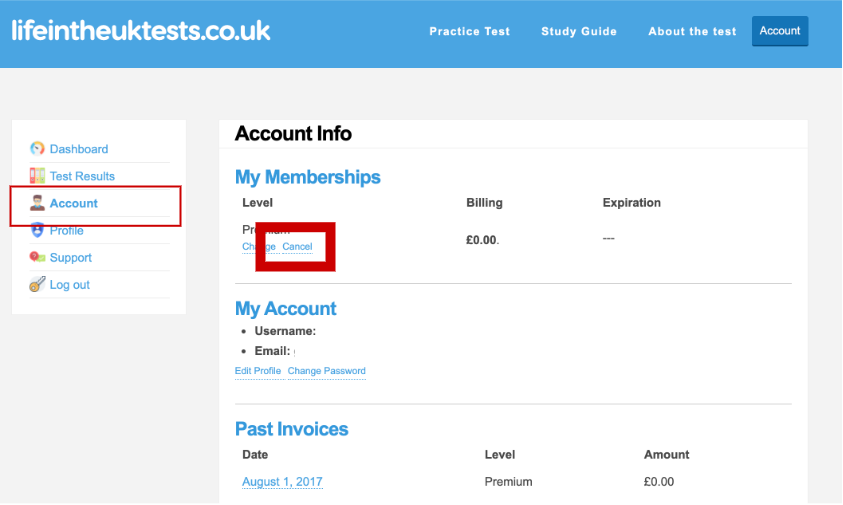
If you have difficulties canceling your membership, please contact us using our contact form.
I wish to submit feedback
We appreciate your feedback and take it very seriously. Submit customer feedback/complaints/testimonials using the contact form.
I wish to make a contribution
We are very thankful for every contribution that we get. By contributing, you are helping thousands of people who are studying for the test and making our community a happier place. There are a number of ways in which you can contribute, which you can read on this page.